 EN
EN

Rethinking the Foundation Introducing the Maple Unified Base Reformer
Jul.30.2026
The classical Pilates reformer has stayed largely unchanged for decades. That is, in many ways, a testament to how well the original design works. The proportions, the spring system, the carriage mechanics — these elements have proven themselves across generations of practitioners and remain the foundation of the apparatus today.
But staying faithful to the classical form does not mean the design has nothing left to offer. At Jereathy, we spend considerable time in studios, talking with instructors and observing how equipment is actually used across a full working day. What we kept noticing were small but consistent friction points — moments where the apparatus itself, rather than the practice, created unnecessary difficulty. The Maple Unified Base Reformer is our response to two of those friction points in particular.
Starting from the Ground Up
The traditional reformer stands on four individual legs — two at the front, two at the rear. It is a stable configuration, and for most purposes it works well. But four legs means four contact points, each carrying a concentrated load. On hardwood floors, that concentration creates pressure marks over time. During dynamic lower-body movements, there is a subtle but perceptible flex that experienced practitioners can feel, particularly on the front end of the frame.
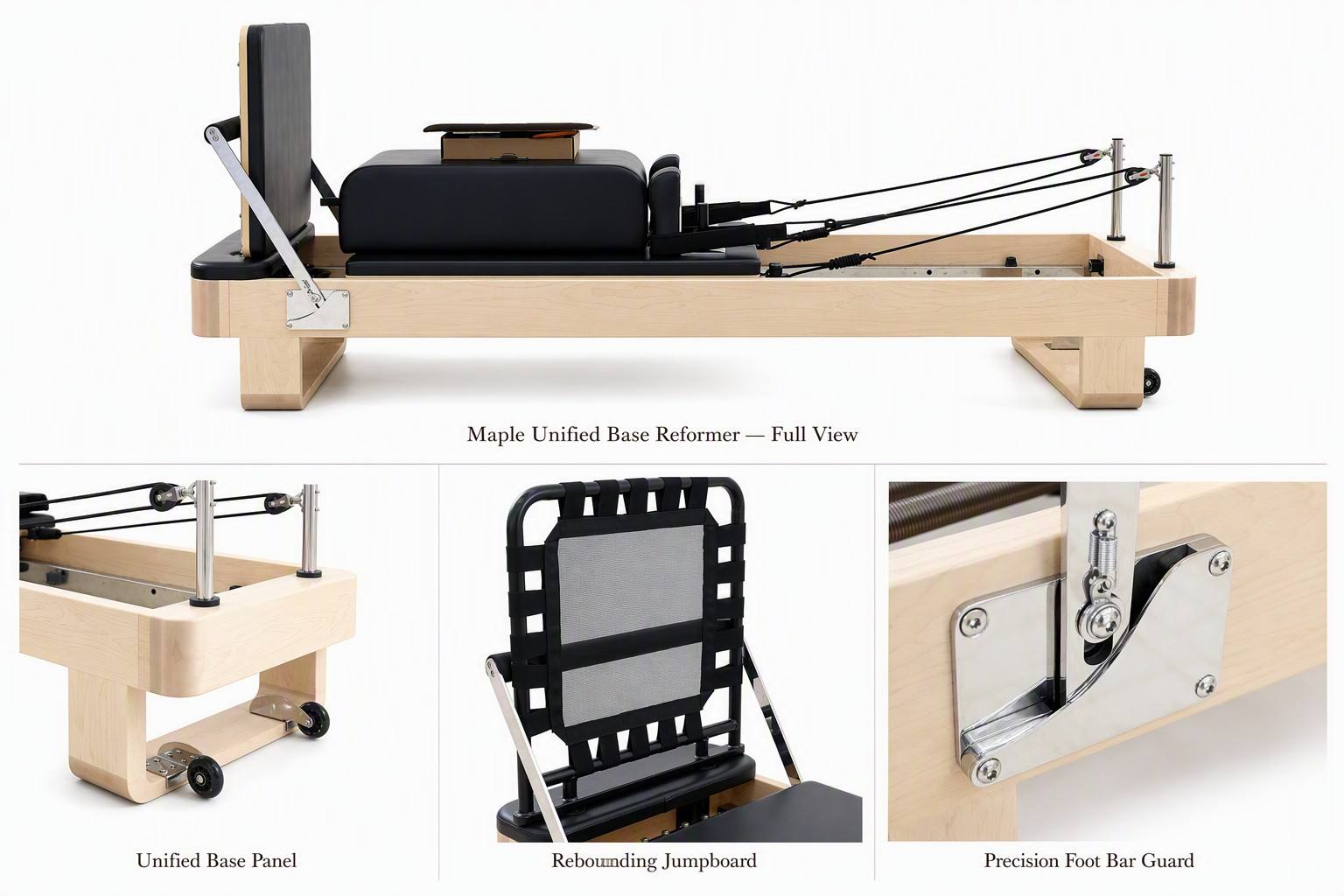
The Unified Base redesigns both pairs of legs. Instead of two separate front legs and two separate rear legs, each pair is merged into a single continuous solid maple base panel. The panel runs the full width of the reformer at each end, and its contact area with the floor is substantially larger than the combined footprint of the four individual legs it replaces.
The practical effects are immediate. The reformer sits more firmly. During footwork, jumping sequences, and any exercise that involves weight shift or dynamic load, the increased ground contact keeps the frame planted. Floor protection improves as well — the load is distributed across a broader surface rather than concentrated at four points.
What we did not anticipate fully during development was how useful the flat upper surface of the base panels would turn out to be. The width of each panel creates a natural shelf at both ends of the reformer. With a simple add-on mount, that surface can hold a dumbbell rack, keeping weights within reach during circuit-style sessions without taking up additional floor space. The rack configuration — whether fitted to one end or both, and in what size — is fully customizable. It is a functional benefit that emerged directly from the structural change, not something we designed for separately.
A Better Foot Bar, in the Details
The second change is smaller in scale but equally consistent in its impact. The foot bar on any reformer takes a significant amount of incidental contact during a typical session. Feet press against it, hands grip it for balance, and in a busy studio, the mechanism beneath it accumulates dust and cleaning residue in ways that are genuinely awkward to address.
On the Unified Base Reformer, the foot bar assembly includes an integrated guard panel machined from the same solid maple as the frame. The panel encloses the mechanism without interfering with any of its adjustable positions. It prevents accidental impact from feet or equipment, keeps the visual line of the apparatus clean and coherent, and makes the entire area straightforward to wipe down between clients.
It is a detail that takes about thirty seconds to appreciate and probably another few sessions to fully notice the absence of frustration it eliminates.
On the Choice of Hard Maple
The frame material for this reformer is solid hard maple — not maple veneer, not a maple composite, but the same dense, close-grained hardwood used in professional flooring and high-end furniture where surface durability is non-negotiable.
Hard maple is one of the harder domestic hardwoods available, with a Janka rating that places it well above the softer species more common in entry-level equipment. It machines cleanly, holds fasteners securely, and does not develop the soft spots or surface movement that affect equipment under years of daily commercial use. Its color — a pale, almost luminous cream with fine, consistent grain — gives the finished reformer a bright, contemporary presence that works in traditional studio environments and modern minimalist spaces equally well.
Each piece of maple carries its own grain pattern, which means no two reformers are identical. That is not a manufacturing limitation. It is one of the characteristics that distinguishes solid wood furniture from engineered alternatives, and it is something practitioners who spend significant time with their apparatus tend to notice and value.
Customization as a Starting Point, Not an Afterthought
The Maple Unified Base Reformer is available in the standard configuration, but the standard configuration is genuinely just a starting point. Spring count and color-coding can be specified to match your resistance preferences and studio aesthetic. The standard jumpboard can be upgraded to a rebounding elastic model for practitioners who incorporate low-impact cardio into their sessions. Logo branding — engraved, printed, or inlaid — is available in multiple methods to suit different material preferences. And the base panel accessory mount can be configured to your exact specifications in terms of size, shape, and placement.
Minimum order quantity is one unit, which means these customization options are accessible to independent studio owners and individual practitioners, not only to commercial buyers placing bulk orders.
For Studios and Practitioners Who Pay Attention to Detail
The Maple Unified Base Reformer is not a reinvention. It is a refinement — one built around specific, observable improvements to a design that already works well. The wider base, the integrated foot bar guard, the quality of the maple, and the depth of the customization options combine into an apparatus that rewards close attention.
If you are setting up a studio where equipment reflects the standard of the instruction, or replacing aging apparatus with something built to last through another decade of regular use, this reformer merits a closer look.